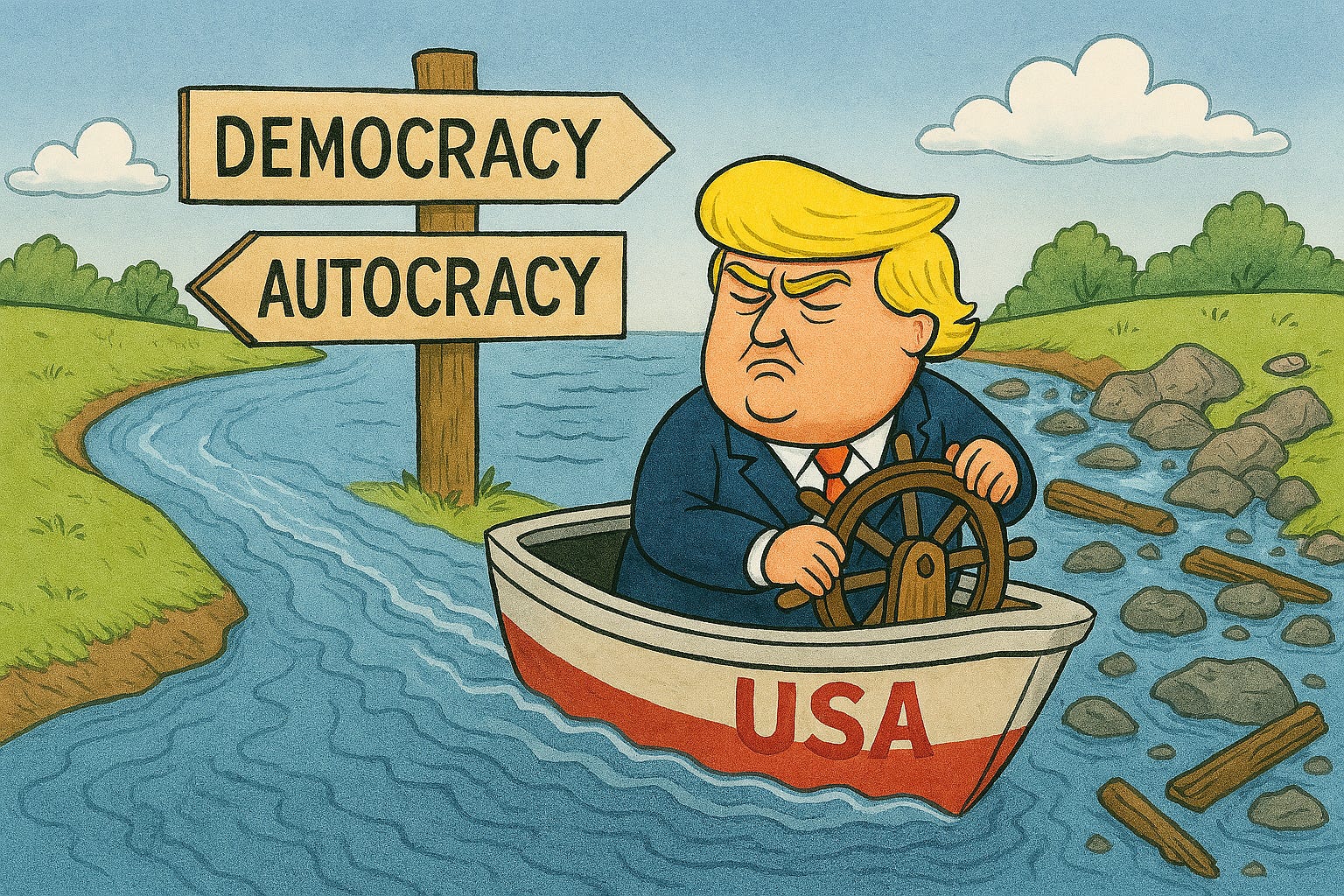
Donald Trump’s return to the White House in January 2025 reignited the intense debates about the future of democracy in America, with many observers, here and abroad, expressing concern that his actions since resuming office represent a deliberate, calculated effort to concentrate power and undermine democratic norms. Almost everything he’s done since his first day in office seems to be steering the country toward authoritarian governance.
Neutralizing Congress and the Courts
A cornerstone of American democracy is the separation of powers among the executive, legislative, and judicial branches, creating a robust system of checks and balances. Since his inauguration, Trump has taken steps that appear designed to weaken, if not obliterate, these institutional safeguards. He has repeatedly challenged judicial independence by publicly criticizing judges who rule against his executive actions and by nominating loyalists to key judicial posts, often bypassing traditional vetting procedures. Congressional oversight has been weakened, sometimes by his administration’s actions and sometimes by the GOP-controlled House and Senate’s abdication of responsibility. Trump has invoked executive privilege at unprecedented levels.
These actions have diminished the ability of Congress and the courts to hold him and his subordinates accountable, and have eroded public trust in the impartiality of government institutions.
Muzzling the Press and Suppressing Dissent
A free press and the right to dissent are vital to a functioning democracy. The Trump administration has conducted an aggressive campaign against media outlets, labeling them as ‘enemies of the people’ and restricting their access to White House events. Journalists have been subjected to surveillance and intimidation, which has a chilling effect on investigative journalism.
New regulations and executive orders have threatened citizens’ rights to organize and participate in protests, with officials citing national security and public order concerns. This stifles open debate, reduces government transparency, and lessens the public’s ability to hold government accountable.
Executive power grab
The administration’s use of executive orders has increased significantly since Trump took office, with many directives bypassing the legislative process and reshaping policy on issues like immigration, environmental regulation, tariffs, and civil rights. The administration has invoked emergency powers to justify actions that circumvent congressional approval, including the reallocation of federal funds and the deployment of federal law enforcement and the National Guard to states and cities without local consent. This centralized White House decision-making reduces the role of other branches of government and undermines the separation of powers.
Weaponizing the law against political opponents
The administration has targeted political opponents and individuals who have earned the president’s ire for selective prosecution, while at the same time granting pardons to individuals convicted of efforts to undermine the 2020 elections, including all those who participated in the Capitol riots on January 6, 2021. The president’s public statements frequently disparage those he opposes or dislikes, creating a climate of fear and division.
These actions not only stifle dissent but also create a belief that the judicial system can be used for political advantage, further undermining the public’s trust and confidence in government institutions.
Manipulating elections
Since taking office for his second term, Trump and his allies across the country have pushed for changes to voting laws that restrict access to the ballot box, particularly for minorities and younger voters. In addition, the administration has sought greater federal control of state election processes, raising concerns about the potential for partisan interference and undermining public confidence in the electoral system.
How far have we gone, and how long will it take to get back?
These are but a few of the actions from the authoritarian playbook that this administration has taken since assuming power ten months ago. The cumulative effect has been a profound weakening of democratic institutions and civil liberties. Checks and balances have been undermined, the media has been compromised, and the electoral process has become less accessible and more politicized. The executive power grabs and targeting of opponents have further polarized an already divided nation, shredding norms of mutual tolerance and respect that are essential to a functioning democracy.
As these changes take root, they become normalized, making it difficult for future leaders to reverse course. Restoring civility and democratic norms after four years of erosion will be a lengthy and challenging process. History suggests that rebuilding trust in government, reestablishing the independence of the judiciary and the oversight role of the legislature, and restoring the integrity of elections will take several election cycles. It will require legislative reforms, institutional rebuilding, and a renewed commitment to democratic values. The process of rebuilding what is destroyed in four years could very well take a decade or more, and it depends on the willingness of future leaders and the public to confront and undo the legacy of authoritarian measures.
The resilience of American democracy has been tested before, but the actions taken since January 2025 represent a challenge of a different magnitude —probably the most significant since the Civil War. Undoing the damage will demand vigilance, civic engagement, and a recommitment to the principles of democracy. The path to recovery will be long, but one has to hope that the enduring strength of American institutions and the determination of its people will ensure the eventual restoration of the democratic norms that we have all too often taken for granted.
Charles A. Ray spent 20 years in the U.S. Army with two tours in Vietnam. He retired as a senior US diplomat, serving 30 years in the U.S. Foreign Service, with assignments as ambassador to the Kingdom of Cambodia and the Republic of Zimbabwe, and was the first American consul general in Ho Chi Minh City, Vietnam. He also served in senior positions with the Department of Defense and is a member of The Steady State.
Founded in 2016, The Steady State is a nonprofit 501(c)(4) organization of more than 360 former senior national security professionals. Our membership includes former officials from the CIA, FBI, Department of State, Department of Defense and Department of Homeland Security. Drawing on deep expertise across national security disciplines including intelligence, diplomacy, military affairs and law, we advocate for constitutional democracy, the rule of law and the preservation of America’s national security institutions.